Latest Readings

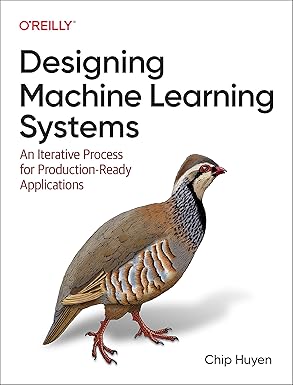
Designing Machine Learning Systems: An Iterative Process for Production-Ready Applications

There is often a massive chasm between a Jupyter notebook with a Sharpe ratio of 3.0 and a live trading strategy that survives execution costs and latency. Chip Huyen’s book is the bridge across that chasm.

While not explicitly written for finance, this is arguably one of the most important books for the “Engineer” part of a Financial Engineer. Huyen moves past the modeling theory (which we usually cover in Hull or Shreve) and aggressively tackles the unglamorous reality of production: data engineering, feature stores, and model monitoring.

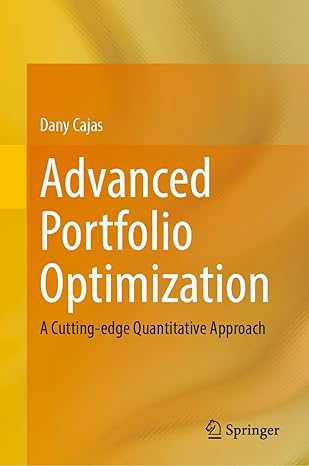
Advanced Portfolio Optimization: A Cutting-edge Quantitative Approach

If Markowitz is the “Old Testament” of portfolio theory, Dany Cajas has written the modern implementation manual. This book effectively serves as the theoretical companion to the widely used Python library Riskfolio-Lib, bridging the gap between academic formulas and cvxpy solvers.

The text moves rapidly past standard Mean-Variance optimization into the territory that actually matters for modern asset management: moments higher than the second, and tail-risk measures. It is refreshing to see a text that treats Convex Optimization not as an abstract math problem, but as a tool for capital allocation.

Quantitative Portfolio Management: The Art and Science of Statistical Arbitrage

This is not a beginner’s guide to trading; it is a masterclass in the physics of financial markets. Isichenko, a physicist with decades of experience at top-tier shops (Thales, Citadel), treats the market as a noisy physical system. The book stands out by rigorously addressing the core problem of quantitative finance: the incredibly low signal-to-noise ratio.

Unlike “cookbook” strategies that expire in months, Isichenko provides a conceptual framework for the entire pipeline—from data ingestion to execution. He dismantles the naive view of prediction and replaces it with a robust framework for managing residuals and costs.

Advanced Portfolio Management: A Quant's Guide for Fundamental Investors

Giuseppe Paleologo has written the definitive manifesto for the “Quantamental” revolution. While traditional quantitative books focus on finding alpha in high-frequency data, this book focuses on applying engineering rigor to discretionary stock picking. It addresses the fundamental question: How do we extract the maximum information ratio from a human analyst’s convictions?

The beauty of this text is its pragmatism. It doesn’t get lost in stochastic calculus but instead uses linear algebra and robust statistics to solve real desk problems: sizing bets, hedging out unwanted factor exposures, and objectively evaluating analyst skill.

Dynamic Hedging: Managing Vanilla and Exotic Options

Before he was the philosopher of “Black Swans,” Taleb was a pit trader, and this book is the undeniable proof. Unlike Hull, which teaches you how to price an option in a vacuum, Taleb teaches you how to survive holding it. It is less about the stochastic calculus of pricing and more about the pathology of hedging.

This is an operational manual for the trading floor. It deals with the messiness of reality: liquidity holes, pinned strikes, and the psychological fatigue of managing a short-gamma book. It treats “Dynamic Hedging” not as a mathematical inevitability, but as a costly, imperfect process.

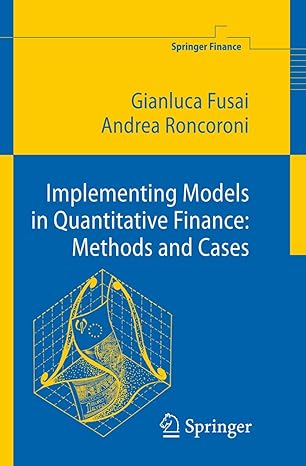
Implementing Models in Quantitative Finance: Methods and Cases

There is often a frustrating disconnect in quant literature: books that explain the stochastic calculus perfectly but leave you clueless on how to code it, and coding books that lack mathematical depth. Fusai and Roncoroni bridge this gap efficiently. This is a “cookbook” in the best sense of the word—focused entirely on the numerical recipes required to build industrial-strength pricing engines.

While the provided code is in MATLAB (which feels slightly dated compared to modern C++/Python stacks), the algorithms are language-agnostic. The authors prioritize stability and speed, which are the only two metrics that matter when your pricer is running inside a risk loop.